

Only foreigners ask why something is done like that

I often tell people that one aspect of the Japanese language makes it easier to learn than, say, English. Conversation here is built on hundreds of stock phrases.
I mean really stock.
These are simple phrases that are repeated word for word…no variances. There’s a drop-down menu for any situation, a raft of free clip art, and you simply insert. Examples would include, “Well, it just can’t be helped,” “Excuse me/sorry/I’m not worthy,” “I’m home,” “I’m leaving,” “It’s hot today,” and “It’s great to have been born Japanese.”
That last one is for them, obviously. Don’t waste your time learning it.
But memorize one of these a day and you’ll be well on your way to conversation skills that will last you a lifetime.
You might say, wait a sec, English speakers have these same expressions. I’d say yes we do, but we change them up like no one’s business. Think about it: we throw in, for no reason whatsoever, a hundred different words for hot, we ditch pat phrases for a sarcastic comment, or simply say “Bro, woah” and roll our eyes. And it’s all understood.
Call that movie you loved cool, sick, or phat, or even say it broke your mind and no one’s lost. And if you ask is the Pope [insert nationality] everyone knows you just said yes.
None of this looseness works in Japanese. Trust me…try saying a movie broke your mind and watch your Japanese neighbors begin to consider you a candidate for the funny farm.
It occurs to me that one stock phrase Japan doesn’t have is “Because that’s the way it has always been done.”
Sure, you can construct this sentence, you can string the right words together to say precisely this, but there isn’t a copy and paste for it because, well….no one asks why something has long been done a certain way.
Tradition is tradition, and it doesn’t get questioned. Certainly not here.
You’ve probably all been hearing that this summer in Japan is a scorcher.
Last week I was in the garden in front of Frog’s Glen. It was maybe 10am and already the sun was burning not only the lawn but the skin off my bare forearms as well. The air was not much more than a low blanket of steam…it was slow suffocation.
If there’s a hot-towel version of waterboarding, this was it.
It’s yearly festival time for this valley. So that morning I hear some clanking, dinging, and drumming approach. A procession of young men carrying an omikoshi portable shrine—the thing weighs at least a ton—came down the path to “shake and dive and swoop” some luck and fortune onto our place. (Instructions to the carriers are simple: the more vigorous and uninhibited the shake/swoop, the greater the luck the gods will grant. Face it, in 34C and 90% steam what else is going to get kids shaking 2,000 pounds of lumber and gold for four hours across the valley?)
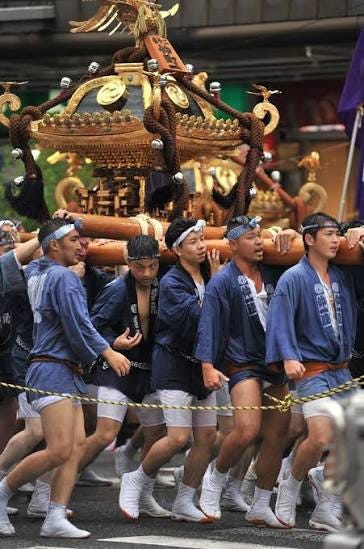
The omikoshi was trailed by some 40 other older, grizzled men who already smelled of beer. Further behind there was a handful of mothers carrying small children and babies.
The procession was on its way ultimately to the village’s shrine up the hill, at least another half mile more. But before that, it was time to shake some fortune out for the Glen.
The boys’ white long-sleeved wear was already soaked through. Below their wet black hair and tightly secured headbands, rivers of sweat poured down faces, disappearing into collars. I don’t know where they had been or how long they had been out, but each looked like he was about to fall to the dirt.
As they approached, I surreptitiously moved a few steps to my left to enter a shadow cast by one of our trees. I hoped they didn’t notice my cowardice. The kids swooped and shook and chanted and yelled. I clapped and said well done—yes, it’s a cut-and-paste stock phrase. They forced smiles onto their tortured faces and wished me health and fortune. The old men (who of course years ago had to do the same duties) barked that they weren’t shaking enough. “Make it good!” “Your ancestors would be ashamed.”
One silver farmer clutching a warm open beer shook his head sadly, cast his eyes to the ground, and croaked, “You’re all lazy.”
All of this in weather you’d associate more with the Mekong Delta than anywhere in the proper northern hemisphere.
Another of the older farmers came to my fence to start a conversation. His brown face was so shiny with running sweat it glared. I felt faint looking at him.
With a big grin he said, “You should join us next year!”
I mumbled something about being 60. “And my doctor sa—”
“I’m 64,” he laughed.
He then paused, clearly waiting for me to say oh really you only look 40. And although I’m a Gemini and am DNA-programmed to say and do whatever makes others happy, I couldn’t in this case. The old leathered rice planter, missing four teeth, already looks 72.
I switched tack and assured him that I had shaken shrines in Tokyo when I was in my twenties. “It taught me to (I lowered my voice so only he could hear) never do that again.”
He bellowed and then with a wink raised his warm Sapporo can as if to say “Tell me about it.”
The kids were finishing up their swooping and carrying on, so I asked if I could get everyone a pitcher of cold water from the house.
“That awaits us at the shine,” another older farmer said more to the boys than to me. He pointed up the hill. I think he was truly enjoying the abuse that his age gives him license to mete out.
“But we thank you! And again, join us next year. Even if to walk with us,” my browned toothless farmer said at the fence. He gestured toward the older contingent and the babies deeper back in the line. I noticed nobody was smiling back there—two squinting mothers were shielding their babies’ faces from the sun with festival pamphlets.
The parade moved on, and I moved quickly back into the air-conditioned house for the rest of the day.
The encounter got me thinking. This is the ninth consecutive year of the Kanto Plain busting heat records. Can you imagine? Nine years in a row, the temperature does nothing but tick slowly up.
Why haven’t these traditions been altered? I thought, “They could be doing this rite just as well at night, or at least during the sundown hours.”
But you know, that’s just a foreigner thinking.
The keyword in Japan will always be tradition. And it’s no use asking why something is done a certain way.
So let us all pray for a long-term cooling trend, knowing that whatever the mercury reads, that hefty gold and wood shrine will be shaken and swooped at 10am in late July forever more.
Well, you just confirmed that I'm a foreigner (urprise, surprise). The festival in our town was last night, too, but it was just too hot. Even though it has always been scheduled for this time of year, why not change the date to the autumn harvest, when it's cooler? ...but that would be too logical.
I am a total foreigner 😂😂😂